translate
Thursday, May 7, 2026
God Loves You But
Friday, August 1, 2025
Hard Life Lessons
Sunday, February 23, 2025
Christianity Can Be Cultish Part 4
Monday, June 24, 2024
Christianity Can Be Cultish Part 3
Language, Attire, & Othering
- omission
- distortion
- lies
Sunday, May 12, 2024
Christianity Can Be Cultish Part 2
Thursday, April 25, 2024
Project Angel Fouls Part 8
Project Angel Fouls Part 7
As a student of both psychology and philosophy, I pay a lot of attention to the whys. Working at Project Angel Food, a well-known Los Angeles nonprofit, has made me realize they operate from a “the end justifies the means” point of view. You may have heard this phrase before, but what does it mean? In my Philosophy classes, I learned this is a logical fallacy (invalid, flawed, error-filled) found in political Consequentialism. Linguistically, Affirmating the Consequences assumes the ending or result of something while also ignoring interferences. In syllagim form it looks like this: if A then B, it’s B therefore A.
For example: recently PAF is having a conflict with my Cesar Chavez Holiday benefit. Our Employee committee voted to have an extra Floating Holiday (8 hrs of basically vacation) on top of our already given one for the year. Thus, every employee would have 16 Floating Holiday hours. However, despite working on the Federal Holiday (my regularly scheduled day) I was informed that I only have 8 hrs of Floating hours because last year there was a glitch that didn’t put a cap on my Floating Holidays resulting in a -8 hrs this year. Despite this being their error and the fact that on my end it shows no request for this third Floating Holiday, they replied “At least you got paid” and “Legally businesses don’t have to give you Holiday benefits.” If (A) you got paid, then (B) you got your holiday benefit. It's (B) therefore (A).
They are ignoring the fact that the pay app constantly has errors and that a holiday benefit is yearly. This can lead to a circular argument.
If (A) you used three Floating Holidays last year and you're only allowed two a yr, then (B) you only get 8 hours this year. It’s (B) therefore (A).
Again they're ignoring Federal Holiday "rules" to pay me less.Another example: In our last Dispatch meeting our Supervisor addressed the ever-present problem of staff conflicts. She called it pride since we weren’t working as a team and to “just help.” She said we shouldn’t ask if it’s within our parameters/scope/department/wants; “we’re here to work so work.” If (A) the staff are not getting along, then (B) it’s their primary fault. It’s (B) therefore (A).
This assumes the problem is one-sided and easy to fix.
If (A) staff just work as a team then (B) there will be less complaints. It's (B), therefore (A)!
This assumes that if staff just do this one thing, everything will get better. As well as ignoring that our complaints aren't about team members. Work culture is created top down.It makes sense that a business would operate in such a way that they are not to blame. It makes sense that a business would justify their ways if it meant making (or keeping) their status (money and power). However, as stated above (and in previous posts), this is a nonprofit. We are for the people, made by the people. PAF time and time again seems to battle this ethical question: who’s important- the clientele, the volunteers, or the staff? When the answer is everyone; however, if the net is weak how will it be a good support? Yes, we serve a very ill clientele. Yes, we need to stay open because hunger never ends. But this does not diminish, rather demands the rights of workers. We need to be constantly reminded of our value just as much as being reminded of our mission.
The logical argument against our flawed one is dennying the consequence: A, then B. It's not B, therefore not A (Modus Tollens) Simply put, it is a logical argument based on deduction and noting the conditionals in either one or both premises. It uses the rule of Inferences. Remember correlation does not mean causation!
If we run this through our two examples without first filter of benefiting profit over people we would change the argument possibly like this:
If (A)all Federal holidays are honored by PAF, there (B) is a benefit for Caser Chavez of +8 Floating holiday hrs by PAF. If there's no (B) benefit given for Cesar Chavez; therefore, not (A).
I am the only I have found having this problem so far. But others has expressed lost vacation and sick hours which runs in the same system.
If (A) the staff are properly equipped and supported with their conflicts, there would be less meetings about not working as a team. If there's no (B) decline in meetings about working as a team; therefore, not (A).
Just telling someone to do something doesn't imply they know how to do it. Although we would want to hire healthy employees, we can't be sure of people's coping mechanisms until the moment arrives. As leaders, will we model the teamwork we expect?
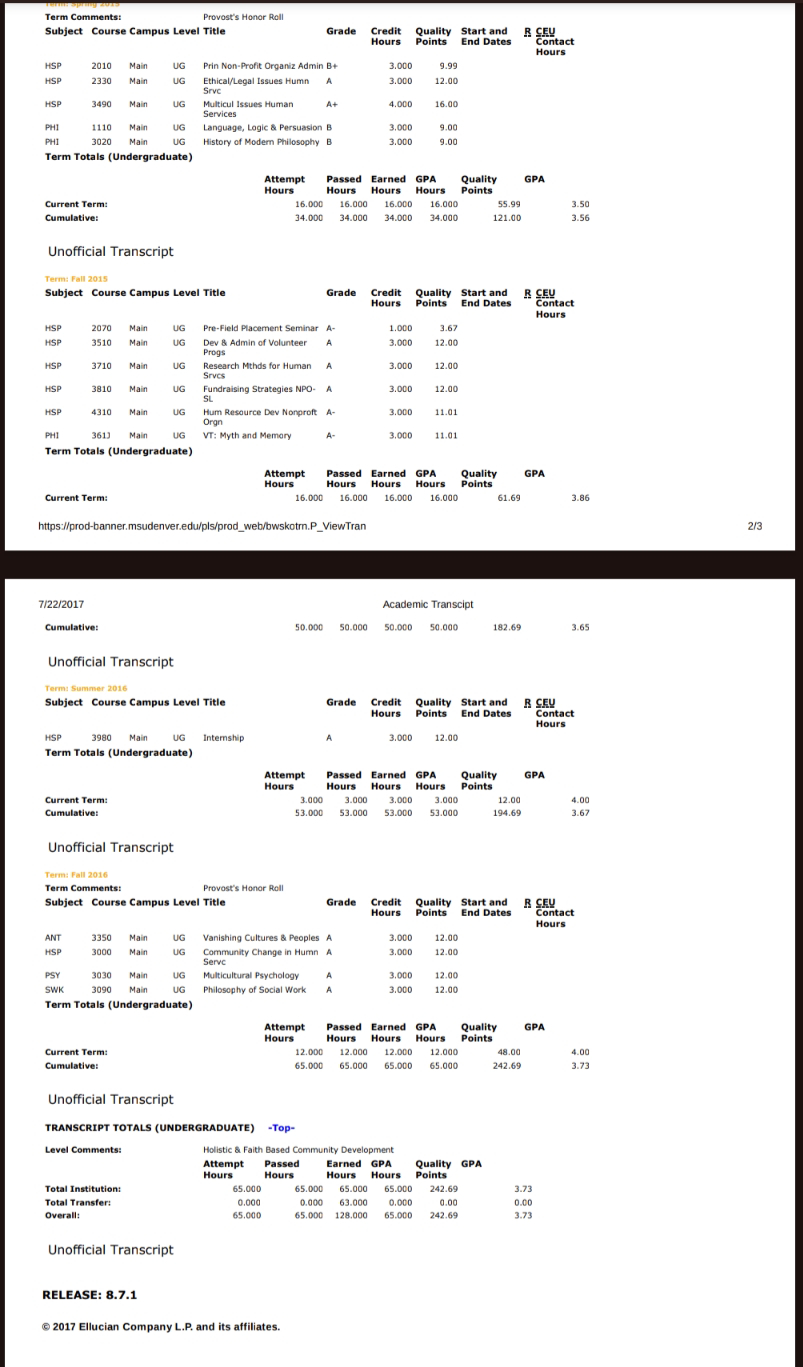
I have studied Principles in Nonprofits, Multicultural Issues in Human Services, Research Methods for Human Services, History of Modern Philosophy, Community Change in Human Services, Multicultural Psychology, and Philosophy of Social Work. I know some things I fear they should have known. We all need to continue to learn and grow. I’ve learned that I can’t trust management at my job. I’ve learned that for PAF, “as long it takes” translates to “by whatever means it takes.” This might seem great, but it’s full of brokenness like the internal fallacies they’ve given sway to. So long story short, I’ve decided to go back to school in hopes of one day taking over my HR’s job…Do you think they’ll cover some of my cost? (It’s in the handbook.)
*For information on this logical fallacy here are some resources to better explain
Affirming the Consequences Video
Friday, December 22, 2023
Project Angel Fouls Part 5
Before I continue listing what is wrong at Project Angel Food, I want to acknowledge what they are doing right:
Increasing their clientele (currently 2,500 pr day*)
Expanding their meal plans to include other critical illnesses (currently 13 tailored meals*)
Continuing to reach large audiences & have large connections
Implementing safety precautions like enforcing food handler training for all staff
Continuing to have thousands of volunteers per year and retaining those same volunteers
Creating an employee committee to address employee concerns
Increasing technology to better handle routes and clients
*Stats from Projects Angel Food
With any progress comes transitions, bumps, and curveballs. These issues are nothing new. The problem lies in how they are being addressed-which is either not at all or a little too late. With increasing numbers comes increased work. As mentioned in previous posts, PAF has practically tripled their employee count since before COVID hit. This has helped with the influx of clients that happened during the same time. I recently spoke with a Client Services worker who noted that there used to be only four staff members in their department compared to the current seven. We estimated that each client services worker has about one hundred+ clients. I asked, “Is this doable?” They responded, “We’re doing it.”
As someone on the frontlines (so to speak), there is a major difference between “doable” and “doing it.” In a classroom setting it’s a good practice to have ten kids per teacher. In case management, the max is about fifty but more reasonable thirty. Having over a hundred clients per staff member means things fall through the cracks. On numerous occasions, I and other drivers have experienced unresponsiveness from CS when needing to reach a client due to an issue. Notes from drivers regarding gate codes, parking, or cancellations that CS is in charge of get delayed sometimes for weeks or worse never added. There have even unfortunately been clients who have moved or deceased and are still on our routes. CS does what it can, but what we need is more staff to meet the mark we’re missing. Doable means logical. Doing it means pushing past our limits.
The increase in meal plans has packed our freezers to the brim so much so that we’ve had to permanently install a trailer freezer in the parking lot which limits the already small number of parking spots. Our expansion/building project has already had its “groundbreaking ceremony” but we probably won’t see actual groundbreaking until summer 2024 or so. This will mean taking over the buildings/businesses next door (the same place that just redid their parking lot a month ago). I had suggested we look into the vacant building a few blocks up Vine which already had the building and parking space we needed, but I’m not sure as to why that was declined or if it was even researched.
Increased meals also have meant more products that we now depend on-like cottage cheese, almond milk, and greek yogurt. Just like the problems we already had with the fruit, sometimes the items shipped aren’t up to our standards and have to be returned or simply arrive late. I understand this is a supplier issue, not ours. However, just like the problems we have with our vans-we CAN NOT depend on one source. We need multiple sources for when the first is unavailable. In the long list of funders we have and the powerful members supporting us, I would suggest partnering with grocery stores and mechanics. Continuous changes and substitutions in our food supply more often than not cause confusion among coworkers. Never has there been an all-staff meeting in Dispatch to show how to pack our special breakfast bags. Instead, we rely on sheets of paper with multiple and continuous edits. Soon only one or two staff members only know how these things are supposed to go while the rest of us are in the dark and then they get angry when others aren’t helping. Managers expect coworkers to teach others along with the volunteers, but the issue is that not everyone is a good teacher and even if they are, arguments arise on who is right-her way or his way? In addition to these directed meetings from managers, I suggest a large whiteboard with the lists and labels on shelves.
Working with vulnerable clientele means we must have work conditions that are higher than most businesses/organizations. Our new Dispatch manager has incorporated that in addition to the face masks we continue to wear in the kitchen, Dispatch should also mimic their dress code of hair nets and gloves. This seems like a wise choice; safety is better than sorry, correct? Food Safety requires these items when working with open or ready-to-eat food. The difference between the kitchen and Dispatch is just that-we work with frozen meals and packaged items, placing them into bags to go back into the freezers for the next day’s delivery. Does it really make sense for someone working in a freezer all day to have to wear a hair/beard net and gloves? It seems more like a waste of our resources than being cautious. There are even talks of a uniform which shouldn’t surprise anyone in the workforce. Personally, I take the stand I did when my high school had the same debate. Uniforms take away individuality and are not economical. If the reason for a uniform is to easily identify who is a staff member versus a volunteer, I have suggested that we have name tags with our pronouns. Earlier this year name tags with our pictures were given, but only to a few people and then it stopped. Again, not sure why?
Technology has significantly gotten better since I began but is still behind. It’s been a year now since we’ve implemented driver cellphones (yes, before we used our personal cell phones) with a client delivery app. This (in addition to the phone holders we finally received with them) has helped in many ways. Our hope is to keep lessening our paper usage, which is wonderful. The complaints from many drivers have been that the app is too clouded with information we don’t need, in a format that doesn’t make sense, and has problems with GPS-leading to an approximate location as opposed to a direct one. I and several drivers have transitioned from Amazon and admit that their delivery app is the one thing they do excellently-it’s sleek, simple, and to the point with the information needed for drivers. Our app has cost a lot of money according to higher-ups. My question is must we stay with it? What was the research that went into what apps are out there? Why couldn’t we again partner with a tech company? PAF doesn’t even have a tech department. It wasn’t until a Dispatch meeting that one coworker spoke up saying they loved working with technology and were willing to help with this app/routing. This was of course after two staff members had quit from the frustrations.
I was invited to join the Committee Staff from HR. They said, “You have great ideas. We need people like you who will bring these things to our attention and bring changes. Now it’s not to make your job easier but to benefit everybody.”
This is why I write. To benefit the body that is called PAF.